
A Guide to Traditional Chinese Acrobatics: Classic Acts
Contortion, aerial silks, hoop diving, plate spinning and chair balancing — what does each classic Chinese acrobatic act really demand of the performers’ bodies?
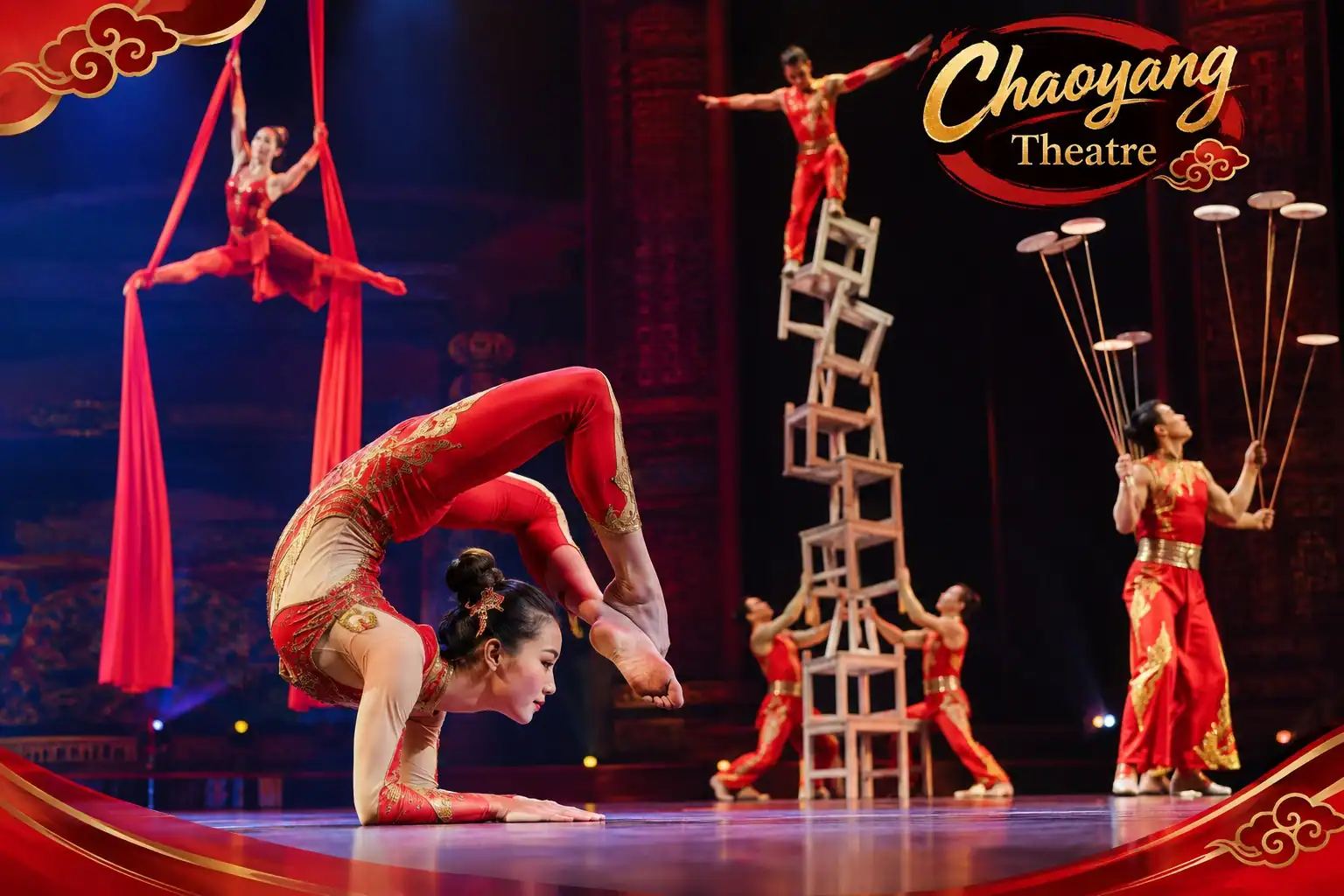
Contortion: Control, Not Just Flexibility
Contortion may look like a pure display of flexibility, but performers regard it as an art of control. Years of training allow them to move their spines and joints through ranges of motion that most people would never attempt, while maintaining complete stillness and balance at the limits of each pose. It is not simply about reaching an extreme position, but about controlling every movement along the way.
Classic contortion acts include backbends, back walkovers and the “scorpion pose”, in which performers bend backwards until their feet touch their heads. Some acts take place inside small boxes, vases or hoops, creating the illusion that the human body can defy its natural limits.
In a fast-paced show, contortion is often one of the quieter, more mesmerising acts. It can also inspire some of the most genuine gasps from the audience, not because of speed or spectacle, but because of the extraordinary control involved.
Aerial Silks, Straps and Hoops
Aerial acrobatics take the performance high above the stage, with performers climbing, wrapping themselves around fabric, dropping through the air and moving between suspended silks, rigid hoops and swinging aerial rings.
These acts demand two distinct abilities. The first is tremendous physical strength, allowing performers to hold themselves in position with one arm, hang upside down or maintain control during a dramatic drop. The second is precise timing, particularly when executing wraps, releases and transitions at exactly the right height and moment.
Unlike fixed apparatus, aerial equipment can swing, rotate and twist independently of the performer. Aerial acrobats must therefore manage momentum as they move, rather than relying on a stable point of support. This added difficulty is often difficult to appreciate from the audience.
Aerial performances are frequently among the most spectacular and visually exhilarating moments of an acrobatic show. Carefully designed lighting often enhances the sense of height and drama, making every movement even more impressive.
Plate Spinning and Diabolo
Plate spinning, known in China as zhuan die (spinning plates), is one of the signature skills of Chinese acrobatics. Performers balance spinning plates on the tips of slender rods, gradually increasing the difficulty by adding more plates or introducing increasingly challenging movements.
Some performers hold the rods with their teeth while keeping the plates spinning, toss and catch plates in mid-air or manipulate several spinning plates simultaneously. Throughout the act, every plate must maintain sufficient speed to remain balanced.
Diabolo, a spinning, spool-shaped prop operated with two handsticks and a connecting string, is closely related to plate spinning in terms of its coordination and timing requirements. It often appears alongside plate spinning in acrobatic performances, featuring throws, catches, transfers and coordinated exchanges between performers.
Both disciplines rely primarily on precise hand movements, timing and coordination rather than brute strength. They are often presented as fast-paced group routines rather than solo performances. The synchronised movements and continuous exchanges between performers are a major part of what makes these acts so lively and entertaining.
Chair Balancing and Human Towers
In a chair-balancing act, performers climb an increasingly tall and unstable tower of chairs, sometimes balancing on little more than the front legs of a chair. At the top, they may perform a handstand or hold another challenging pose while maintaining their balance high above the stage.
Human pyramid acts, also known as human towers, achieve a similar effect without chairs or other equipment. Instead, performers climb onto one another to form increasingly elaborate structures, building a tower entirely out of human bodies.
These acts demand exceptional balance, concentration and courage. With no mechanical devices or visual effects to conceal even the slightest wobble, every movement is clearly visible to the audience.
As each additional chair or performer is added, the tension becomes increasingly apparent. The audience watches as the structure grows taller and more precarious, waiting for the final moment when the performer at the top completes the pose and holds it steadily.
The Globe of Death: A Thrilling Finale
Many Chinese acrobatic shows, including large-scale touring productions, conclude with the Globe of Death, a spherical metal mesh cage in which several motorcycle riders race at high speeds, crossing paths and circling one another within the confined space.
Despite its association with traditional circus performances, the Globe of Death actually originated in early 20th-century Western carnivals. It was initially performed using bicycles before motorcycles were introduced. Chinese acrobatic troupes, like circus companies around the world, subsequently adopted and developed the act into a high-adrenaline spectacle.
Unlike contortion or balancing, the Globe of Death demands less flexibility and more courage, precise throttle control and split-second coordination between riders. Each rider must maintain an exact trajectory and speed while navigating a confined space at high velocity, leaving very little room for error.
Its combination of speed, danger and visual excitement makes it a natural choice for the finale of many acrobatic shows, delivering a dramatic climax rather than opening the performance.
How These Acts Come Together in a Show
A typical evening of Chinese acrobatics does not necessarily follow a storyline like a narrative circus production. Instead, it is usually arranged as a variety show, alternating between quieter, more controlled acts, such as contortion and balancing, and faster, high-energy performances, such as tumbling and plate spinning.
This variety helps maintain the pace of the show, preventing any single style of performance from dominating for too long. As the evening progresses, the programme often builds towards its most visually spectacular acts, frequently featuring aerial acrobatics or the Globe of Death as the grand finale.
The exact acts, their running order and the overall duration vary depending on the troupe, venue and individual performance. Any programme published online in advance should therefore be treated as a general guide to the show’s format rather than a guaranteed schedule for the day of your visit.



Leave a Reply